
Oxalates
Oxalates are a natural part of many healthy foods — the key is balance.
Key points
Oxalates are naturally occurring compounds in many plant foods.
High-oxalate foods can contribute to kidney stone formation in susceptible people.
Rarely, oxalate crystals can deposit in joints (oxalate arthropathy), especially in severe metabolic or gut conditions.
Gut bacteria, including Oxalobacter formigenes, help break down oxalates — dysbiosis can raise oxalate absorption.
Most people can enjoy high-oxalate foods safely with simple pairing and preparation strategies.
Pairing oxalate-rich foods with calcium-rich foods binds oxalates in the gut, reducing absorption.
Cooking or fermenting high-oxalate foods can lower oxalate content.
Staying hydrated dilutes urinary oxalate and calcium, reducing stone risk.
Calcium citrate is the preferred supplement for people with kidney stone history.
Oxalates are not a direct cause of gout, but kidney health supports both gout and stone prevention.
Personal risk varies — those with past kidney stones or gut surgery should be more cautious.
Variety and rotation in plant foods reduce cumulative oxalate load.
What are oxalates?
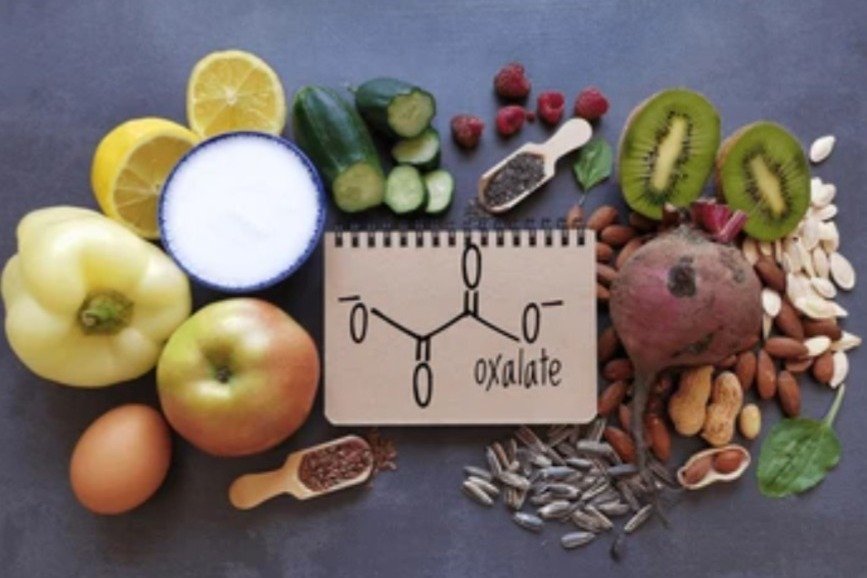
Oxalates (or oxalic acid) are compounds found naturally in plants, where they help regulate minerals. In the human body, oxalates can bind with calcium to form calcium oxalate. If this happens in the gut, the complex is excreted harmlessly in stool. If it happens in urine, it can form kidney stones.
High-oxalate foods include spinach, beetroot, rhubarb, almonds, cashews, peanuts, and some grains and legumes. Many of these foods are nutrient-dense and beneficial in moderation.
Oxalates and arthritis
Oxalates do not directly cause osteoarthritis or rheumatoid arthritis. However:
In rare cases (usually after gut surgery, severe malabsorption, or certain metabolic disorders), oxalate crystals can deposit in joints, causing oxalate arthropathy.
Kidney stones or reduced kidney function from high oxalate loads can impair uric acid clearance, indirectly raising gout risk.
Gut dysbiosis — more common in inflammatory arthritis — may reduce oxalate-degrading bacteria, increasing absorption and urinary oxalate levels.
Gut health connection
A healthy gut microbiome helps break down oxalates before they can be absorbed. The bacterium Oxalobacter formigenes, for example, uses oxalate as its primary energy source. Antibiotics, poor diet, or inflammation can reduce these bacteria, increasing oxalate absorption and stone risk.
Supporting gut health through a diverse, plant-rich diet, prebiotics, probiotics, and minimising unnecessary antibiotic use may help maintain natural oxalate metabolism.
Managing oxalates in your diet
You don’t have to avoid oxalate-rich foods entirely. Instead, use these strategies:
1) Pair with calcium-rich foods
Eat high-oxalate foods alongside calcium-rich options like canned salmon with bones, dairy, fortified plant milks, tofu set with calcium, or low-oxalate greens. This binds oxalate in the gut, reducing absorption.
2) Cook or ferment
Boiling, steaming, or fermenting certain vegetables can reduce oxalate content. Discard the cooking water.
3) Stay hydrated
Adequate fluid intake dilutes urinary oxalate and calcium, reducing stone formation risk.
4) Choose the right supplement
If you take calcium supplements, calcium citrate is often preferred for those with stone history — it can lower urinary oxalate.
5) Rotate and vary
Don’t eat the same high-oxalate food in large amounts daily. Rotate choices to keep cumulative intake balanced.
6) Support your gut microbiome
Include prebiotic fibres, fermented foods, and overall dietary variety to encourage oxalate-degrading bacteria.
Oxalates and gout
Gout is caused by uric acid crystals, not oxalate crystals. However, healthy kidney function is important for clearing both uric acid and oxalate. Recurrent kidney stones or chronic kidney disease can indirectly make gout more likely.
Quick reference – high-oxalate foods
Spinach
Beetroot
Rhubarb
Almonds, cashews, peanuts
Sweet potatoes
Swiss chard
Soy products (some)
Wheat bran
Black tea (brewed strong)
References
Holmes RP, Assimos DG. “The impact of dietary oxalate on kidney stone formation.” Urolithiasis. 2016;44(1):3–9.
Siener R. “Impact of dietary habits on stone incidence.” Urolithiasis. 2021;49(2):129–136.
Ticinesi A et al. “Oxalate and gut microbiota interactions: a review.” Nutrients. 2020;12(9):2676.
Lange JN et al. “Role of calcium in oxalate stone disease.” J Am Soc Nephrol. 2012;23(9):1446–1453.
Holmes RP, Knight J. “Oxalate and calcium homeostasis.” Clin Rev Bone Miner Metab. 2018;16:64–71.
Monico CG, Milliner DS. “Genetics of primary hyperoxaluria.” Semin Nephrol. 2008;28(2):122–130.
Siener R et al. “Effect of calcium supplementation on urinary oxalate excretion.” J Urol. 2003;169(2):550–553.
Khan SR. “Crystal-induced inflammation of the kidneys: results from human studies, animal models, and tissue-culture studies.” Clin Nephrol. 2018;89(2):108–118.
Taylor EN, Curhan GC. “Dietary calcium from dairy and nondairy sources, and risk of symptomatic kidney stones.” J Urol. 2013;190(4):1255–1261.
Lieske JC et al. “Diet, but not oral probiotics, effectively reduces urinary oxalate excretion and calcium oxalate supersaturation.” Kidney Int. 2010;78(11):1178–1185.
This page is for educational purposes only and is not a substitute for personalised medical advice.